Nutrient solution pH
pH affects how well roots can take up the nutrients in your feed. If it's off, plants can come up short on some nutrients even when the feed has plenty. Here are the ranges to aim for, why pH drifts, and how to adjust it. For EC, see the EC guide.
What pH does
pH is a measure of how acidic or basic a solution is, on a scale of 0 to 14. Seven is neutral. Lower is more acidic. Each whole number is a tenfold change, so pH 5 is ten times more acidic than pH 6.
pH affects what form nutrients are in. Iron, manganese, zinc and phosphorus stay dissolved and available in a slightly acidic solution. If pH gets too high, they form compounds roots can't take up. If it gets too low, calcium and magnesium become harder to get, while manganese and iron can build up to levels that hurt the plant.
Yellow new leaves with green veins are a sign of iron deficiency. Often there's enough iron in the feed and the pH is too high for roots to take it up. Lower the pH before adding more iron.
Targets
Most crops do well in a fairly narrow range. Soilless mixes and hydroponics are kept lower than soil. Soil has clay and organic matter that help keep nutrients available at a higher pH.
A tank at 5.8 one day and 6.2 the next is fine. Aim for the middle of the range and only adjust when it moves outside it.
Drift
pH changes over time for three main reasons.
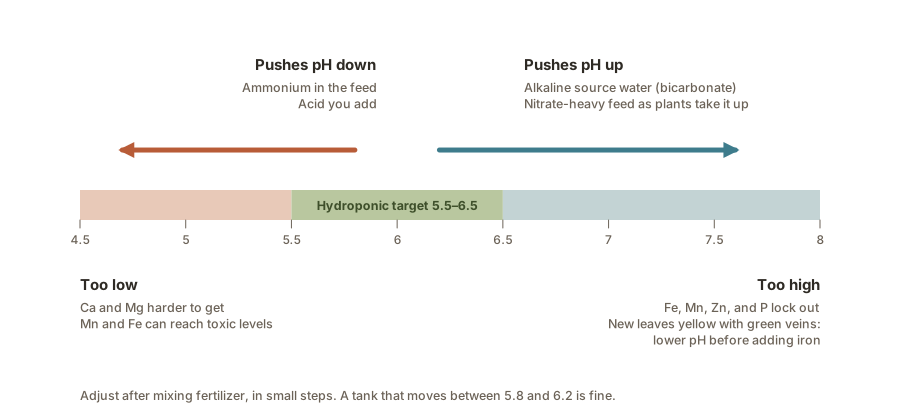
- Your water. Most well and city water carries alkalinity, mainly bicarbonate. Alkalinity neutralizes acid and raises pH over time. It matters more than the water's pH. Water at pH 8 with low alkalinity takes little acid to correct. Water at pH 7.5 with high alkalinity takes much more, and keeps raising pH. A water test shows your alkalinity.
- The form of nitrogen. Roots taking up nitrate raise the pH around them. Roots taking up ammonium lower it. Feeds with more ammonium lower pH over time, and feeds that are mostly nitrate raise it.
- The plants themselves. In a recirculating system, pH changes as plants take up water and nutrients. Check it daily.
Adjusting
Mix in the fertilizer before checking pH. Fertilizer changes the pH, so if you adjust the water first you'll have to adjust it again.
- Add acid (pH down) or base (pH up) in small amounts.
- Stir or circulate for a few minutes, then read again.
- Stop once it's in range. It doesn't need to hit an exact number.
Each time you overshoot and correct back, you add more salts to the tank. If you need pH down every day, treat the water's alkalinity or switch some of the nitrogen to ammonium.
pH meters lose accuracy over time. Calibrate with fresh buffer solutions (usually 7.0 and 4.0) every week or two, and store the probe wet. A meter that reads 0.4 high will have you adding acid you don't need.
Summary
- pH affects how well roots can take up nutrients.
- Hydroponics and soilless mixes run around 5.4 to 6.5. Soil runs higher.
- Yellow new leaves with green veins often mean pH is too high for iron uptake.
- Water alkalinity and the type of nitrogen cause most pH drift.
- Mix the feed first, adjust in small steps, and stop once it's in range.
Sources
University extension publications.
- Dunn, B. and H. Singh, Oklahoma State University Extension, "Electrical Conductivity and pH Guide for Hydroponics" ↗. Hydroponic pH ranges and why pH sets nutrient availability.
- University of Georgia Extension, "EC and pH: What Is It and Why Does It Matter?" ↗. Substrate pH targets and the high and low pH problems.
- University of Massachusetts Amherst Extension, "Water Quality: pH and Alkalinity" ↗. Why alkalinity, not water pH, drives drift.
- Nelson, P.V. and Bailey, D.A., NC State, "Water Quality," N.C. Flower Growers' Bulletin 39(3), 1994 ↗. Alkalinity and acid injection.
Keep reading
Mulder's chart
The nutrient interaction wheel, with a source for each line. Tap a nutrient to see what it blocks, what it helps, and which lines have no evidence.
14 min read NutritionCalcium disorders
Blossom-end rot and tipburn are calcium problems caused by slow transpiration more often than by too little calcium in the feed. Causes and fixes for tomatoes and lettuce.
4 min read IndexAll Bizon guides
Everything published so far, and what is being written next.
Browse the guides