Top dressing
Top dressing means adding compost, worm castings or a dry fertilizer to the surface of a pot or bed. Bags list a rate, but usually not for your pot size. Below are the four kinds of rate you'll see on a bag and how to work out the amount for each.
Four kinds of rate
Labels list a rate in one of four ways. Check which one yours uses first, because each one uses a different pot measurement.
Worked examples
These all use a 5-gallon pot that's 12 inches across the top.
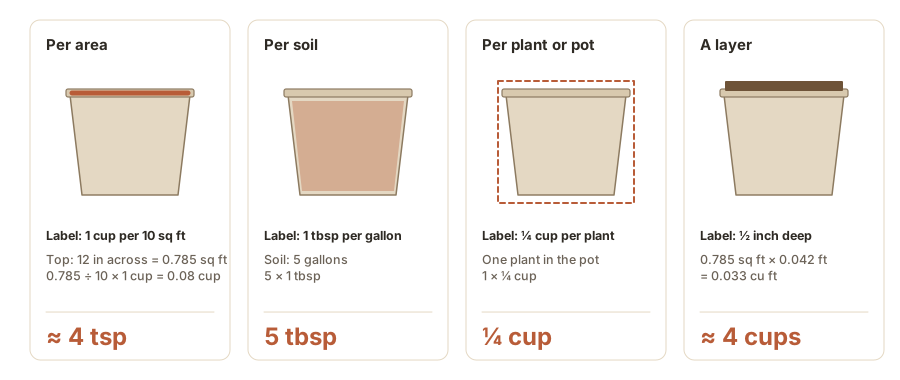
Per area. A 12-inch circle is 0.785 sq ft (3.14 × 0.5 ft × 0.5 ft). At 1 cup per 10 sq ft, that pot gets 1 × 0.785 / 10 = 0.0785 cup, a little under 4 teaspoons.
Per soil. At 1 tablespoon per gallon of soil, the pot gets 5 tablespoons. The top area isn't used.
A layer. Half an inch is 0.042 ft. Area times depth is 0.785 × 0.042 = 0.033 cubic feet, close to 4 cups.
For the same pot, the per-area rate came to 4 teaspoons and the per-soil rate came to 5 tablespoons, about four times more. Products are labeled differently, so always use the rate on your bag.
Common mistakes
- Treating a pot like a bed. A per-area rate written for a garden bed works for a pot too. Use the area of the top of the pot, not its volume.
- Swapping cups for pounds. A cup of compost and a cup of granular fertilizer weigh very different amounts. If the label gives pounds and you only have a scoop, weigh one scoop of that product first.
- Rounding up. Too much dry fertilizer can burn roots, especially in small pots. Round down if you're not sure.
- Skipping the water. Water after top dressing so it settles into the soil.
Pesticide labels are legally binding. Use the rate and method on the label, and only on the plants and sites it lists.
Summary
- Check which kind of rate the bag gives before doing any math.
- Per-area rates use the top of the pot. Per-soil rates use how much soil it holds.
- To convert between cups and pounds, weigh a cup of that product.
- Round dry fertilizer down, not up, and water it in.
- Pesticide labels are the law. Follow them exactly.
Sources
The examples are unit arithmetic. The label rule is from the EPA.
- U.S. Environmental Protection Agency, "Introduction to Pesticide Labels" ↗. Why a pesticide label is legally binding.
Keep reading
Mulder's chart
The nutrient interaction wheel, with a source for each line. Tap a nutrient to see what it blocks, what it helps, and which lines have no evidence.
14 min read NutritionCalcium disorders
Blossom-end rot and tipburn are calcium problems caused by slow transpiration more often than by too little calcium in the feed. Causes and fixes for tomatoes and lettuce.
4 min read IndexAll Bizon guides
Everything published so far, and what is being written next.
Browse the guides