Plant Problem Diagnosis Key / Pests
Spongy moth (gypsy moth)
Lymantria dispar
An invasive moth whose hairy caterpillars strip oaks and many other trees in late spring. Trees that lose more than half their leaves two years running are weakened and may die. The hairs irritate skin.
Signs
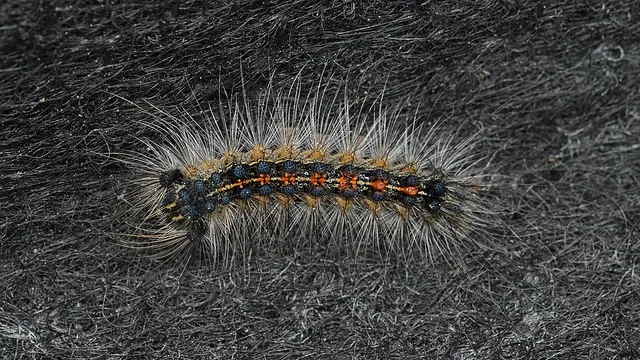
- Hairy caterpillars with five pairs of blue dots then six pairs of red dots down the back.
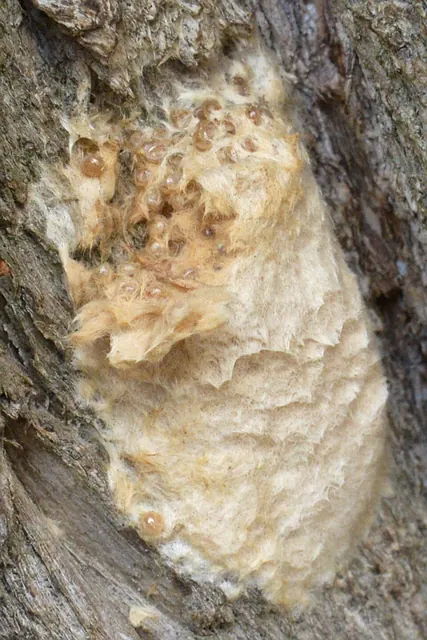
- Tan, fuzzy egg masses about 1 to 1 1/2 inches long on bark, stones and outdoor objects.
- Trees stripped from late spring into early summer, with dark pellet droppings piling up below.
What favors it
Oak, aspen, birch, willow, apple, linden and many other hosts.
Prevention
- Scrape egg masses from bark and outdoor objects into soapy water from fall to early spring.
- Check campers, firewood and outdoor furniture for egg masses before leaving a quarantine area.
Crops it shows up on
Shade & ornamental trees; Evergreens & conifers (pine, spruce, juniper); Apple, pear & stone fruit.
Often confused with
Sources
- Spongy MothRutgers Cooperative Extension
- Spongy moth management guide for homeownersUniversity of Wisconsin-Madison Extension
- Spongy Moth Caterpillars on TreesUniversity of Maryland Extension
Treatment by crop
Cultural, biological and chemical options in the order to use them, and notes written for each crop.
Identification is free. Treatment is on the Home and Pro plans.
Questions in the key that lead here
- Look the plant over, leaf undersides included. Are insects, mites, slugs, eggs, webbing or droppings on it?
Yes, something living or its traces - What is on the plant?
Something chewing - What is doing the chewing?
Silk tents, webs or hanging bags in tree branches - What is in the branches?
Hairy caterpillars with blue and red dots down the back
Not a match? Start the key or describe what you see.
More photos
More from university Extension: search Extension pages on spongy moth, or find a plant diagnostic lab through your state's Extension.
Other pests
- Aphids
- Bagworms
- Bark beetles of pine and spruce
- Broad mites and cyclamen mites
- Caterpillars
- Cicada and twig-cutting damage
- Colorado potato beetle
- Cucumber beetles
- Cutworms
- Elm leaf beetle
- Emerald ash borer
- Flea beetles
- Fungus gnats
- Galls on leaves and twigs
- Hemlock woolly adelgid
- Japanese beetles
- Lace bugs
- Leafminers
- Mealybugs
- Pine sawflies
- Root aphids
- Root-knot nematodes
- Russet mites
- Sapsucker damage
- Scale insects
- Shore flies
- Slugs and snails
- Spider mites
- Spotted lanternfly
- Squash bugs and stink bugs
- Squash vine borer
- Tent caterpillars and fall webworm
- Thrips
- Whiteflies
- Wood borers