Plant Problem Diagnosis Key / Diseases
Cedar-apple and related rusts
Gymnosporangium spp.
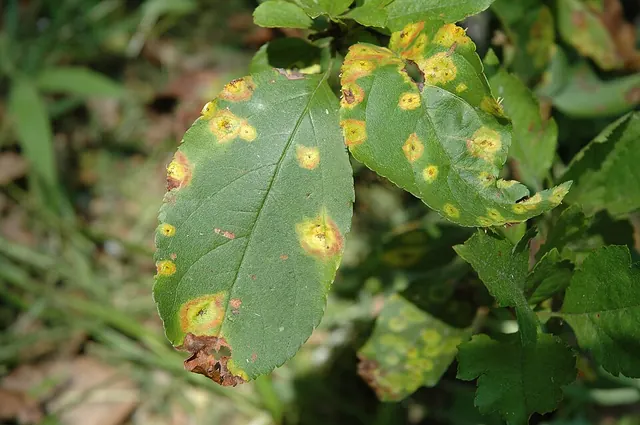
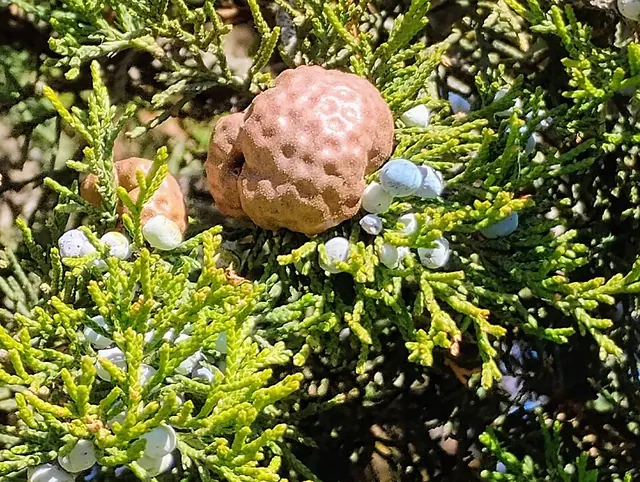
Rust fungi that need two hosts: juniper or red cedar, and apple, crabapple, hawthorn, pear or serviceberry. Spores from orange jelly horns on juniper galls in spring infect the apple-family leaves, and spores from those go back to the junipers from midsummer to early fall.
Signs
- Bright orange-yellow spots on apple-family leaves and fruit, later with tiny tubes or cups underneath.
- Brown, woody galls on juniper twigs that push out orange jelly-like horns in wet spring weather.
- Early leaf drop on susceptible crabapple and apple varieties.
What favors it
Juniper or red cedar within a few hundred feet of apple-family trees (spores can travel miles), and wet, mild spring weather when the jelly horns release spores.
Prevention
- Plant rust-resistant apple, crabapple and hawthorn varieties.
- Keep junipers and apple-family trees apart where you can.
- Prune galls off nearby junipers before the jelly horns form in spring.
Crops it shows up on
Apple, pear & stone fruit; Shade & ornamental trees; Evergreens & conifers (pine, spruce, juniper).
Often confused with
Sources
- Cedar-Apple RustMontana State University Extension
- Cedar-Hawthorn RustMontana State University Extension
- Cedar-Apple RustUW-Madison Plant Disease Diagnostics Clinic
- Cedar-apple rustUniversity of Illinois Extension
Treatment by crop
Cultural, biological and chemical options in the order to use them, and notes written for each crop.
Identification is free. Treatment is on the Home and Pro plans.
Questions in the key that lead here
- Look the plant over, leaf undersides included. Are insects, mites, slugs, eggs, webbing or droppings on it?
No, only damage or discoloration - Where is the problem?
A tree or shrub - Which part of the tree or shrub shows the problem?
Needles of a pine, spruce, fir, juniper or arborvitae - What is happening to the needles?
Something growing on the branches - What is on the branches?
Brown balls that grow orange jelly-like horns in wet spring weather
Not a match? Start the key or describe what you see.
More photos
More from university Extension: search Extension pages on cedar-apple and related rusts, or find a plant diagnostic lab through your state's Extension.
Other diseases
- Anthracnose
- Apple scab
- Bacterial leaf scorch
- Bacterial leaf spot
- Bacterial wetwood (slime flux)
- Bacterial wilt of cucurbits
- Black knot
- Black spot of rose
- Bleeding canker
- Boxwood blight
- Canker diseases
- Crown gall
- Damping-off
- Downy mildew
- Dutch elm disease
- Early blight and Alternaria leaf spot
- Elm yellows (phloem necrosis)
- Fire blight
- Fusarium wilt
- Gray mold (Botrytis)
- Late blight
- Mosaic viruses
- Needle cast and tip blight
- Oak wilt
- Powdery mildew
- Root and butt rot
- Root rot (Pythium and Phytophthora)
- Rust
- Septoria leaf spot
- Shade tree anthracnose
- Sooty mold
- Tar spot of maple
- Tomato spotted wilt and impatiens necrotic spot viruses
- Verticillium wilt
- White mold (Sclerotinia)
- White pine blister rust