Plant Problem Diagnosis Key / Diseases
Crown gall
Agrobacterium tumefaciens
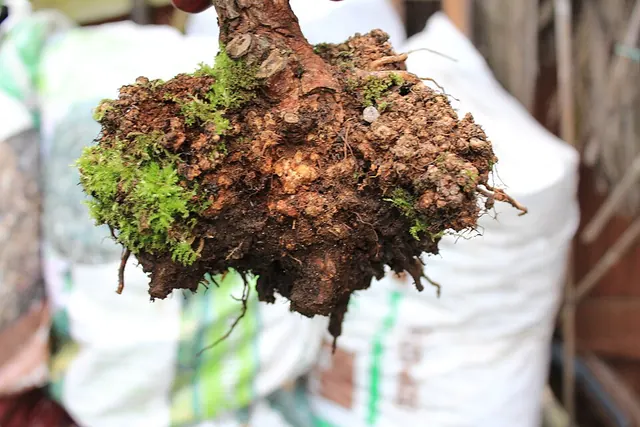
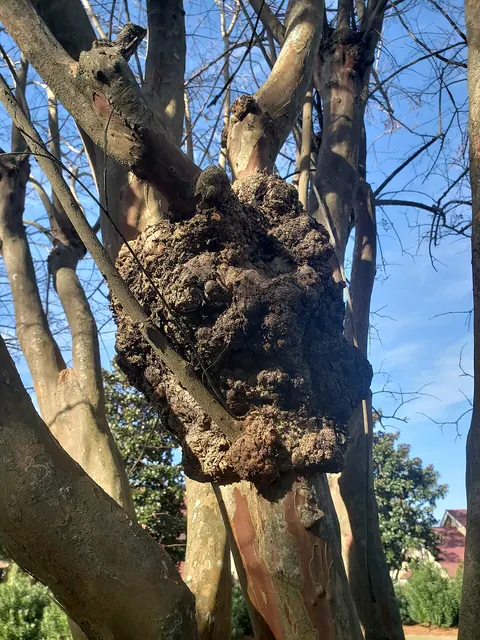
A soil bacterium that enters through wounds near the soil line and makes the plant grow rough, woody tumors. It is common on rose, euonymus, willow, poplar and fruit trees; young plants can be stunted or killed, while old trees often live with it for years.
Signs
- Rough, tumor-like lumps at the soil line, on the roots or on lower stems.
- Galls start small, light and soft, then turn dark, woody and cracked.
- Slow growth, small leaves and dieback on badly galled plants.
What favors it
Wounds at the soil line from planting, cultivating, mowers, grafting and insects, in soil where infected plants grew before.
Prevention
- Buy plants with no lumps on the roots or at the soil line.
- Avoid wounding roots and the base of the stem when planting and weeding.
- Where it has been a problem, plant grass there for 3 years, or resistant trees such as beech, ginkgo, holly, magnolia or conifers; the bacteria live in the soil.
Crops it shows up on
Apple, pear & stone fruit; Roses & ornamentals; Shade & ornamental trees.
Often confused with
Sources
- Crown gallUniversity of Minnesota Extension
- Crown GallUniversity of Wisconsin-Madison Extension
- Crown GallMontana State University Extension
- Crown GallUMass Amherst Extension
Treatment by crop
Cultural, biological and chemical options in the order to use them, and notes written for each crop.
Identification is free. Treatment is on the Home and Pro plans.
Questions in the key that lead here
- Look the plant over, leaf undersides included. Are insects, mites, slugs, eggs, webbing or droppings on it?
No, only damage or discoloration - Where is the problem?
A tree or shrub - Which part of the tree or shrub shows the problem?
The base of the trunk or the roots - What do you see at the base?
Rough, woody, tumor-like lumps at the soil line or on the roots
Not a match? Start the key or describe what you see.
More photos
More from university Extension: search Extension pages on crown gall, or find a plant diagnostic lab through your state's Extension.
Other diseases
- Anthracnose
- Apple scab
- Bacterial leaf scorch
- Bacterial leaf spot
- Bacterial wetwood (slime flux)
- Bacterial wilt of cucurbits
- Black knot
- Black spot of rose
- Bleeding canker
- Boxwood blight
- Canker diseases
- Cedar-apple and related rusts
- Damping-off
- Downy mildew
- Dutch elm disease
- Early blight and Alternaria leaf spot
- Elm yellows (phloem necrosis)
- Fire blight
- Fusarium wilt
- Gray mold (Botrytis)
- Late blight
- Mosaic viruses
- Needle cast and tip blight
- Oak wilt
- Powdery mildew
- Root and butt rot
- Root rot (Pythium and Phytophthora)
- Rust
- Septoria leaf spot
- Shade tree anthracnose
- Sooty mold
- Tar spot of maple
- Tomato spotted wilt and impatiens necrotic spot viruses
- Verticillium wilt
- White mold (Sclerotinia)
- White pine blister rust