Plant Problem Diagnosis Key / Diseases
White pine blister rust
Cronartium ribicola
A rust fungus of five-needle pines that also needs currants or gooseberries nearby to complete its life cycle. It forms swollen cankers on branches and the trunk, and a canker that reaches the trunk kills the top or the whole tree.
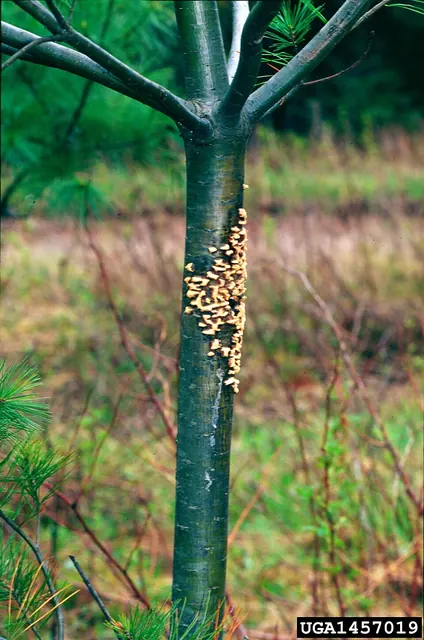
Signs
- One branch with all its needles turning yellow, then rusty red.
- A swollen, rough canker on the branch or trunk, oozing sticky clear-to-white sap.
- White to yellow blisters at the canker edge in spring that burst with orange powder.
What favors it
Currants and gooseberries nearby, especially within 200 feet, cool, moist sites, and low branches within 10 feet of the ground.
Prevention
- Plant rust-resistant white pine selections, and only rust-resistant currants and gooseberries near pines.
- Prune the lower third of white pines every few years until there are 9 feet of clear trunk, never more than half the live crown; most lethal infections start within 10 feet of the ground.
Crops it shows up on
Evergreens & conifers (pine, spruce, juniper).
Often confused with
Sources
- White pine blister rustUniversity of Minnesota Extension
- White Pine Blister RustUniversity of Wisconsin-Madison Plant Disease Diagnostics Clinic
- White pine blister rust managementMinnesota Department of Natural Resources
Treatment by crop
Cultural, biological and chemical options in the order to use them, and notes written for each crop.
Identification is free. Treatment is on the Home and Pro plans.
Questions in the key that lead here
- Look the plant over, leaf undersides included. Are insects, mites, slugs, eggs, webbing or droppings on it?
No, only damage or discoloration - Where is the problem?
A tree or shrub - Which part of the tree or shrub shows the problem?
The trunk or bark - What is in or on the bark?
Cracks, knots, lumps or blisters on the trunk or branches - What is on the trunk or branches?
Orange blisters, or a swollen, sap-oozing canker
Not a match? Start the key or describe what you see.
More photos
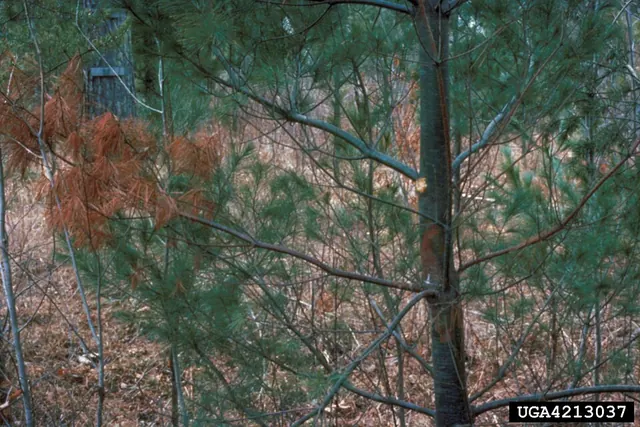
More from university Extension: search Extension pages on white pine blister rust, or find a plant diagnostic lab through your state's Extension.
Other diseases
- Anthracnose
- Apple scab
- Bacterial leaf scorch
- Bacterial leaf spot
- Bacterial wetwood (slime flux)
- Bacterial wilt of cucurbits
- Black knot
- Black spot of rose
- Bleeding canker
- Boxwood blight
- Canker diseases
- Cedar-apple and related rusts
- Crown gall
- Damping-off
- Downy mildew
- Dutch elm disease
- Early blight and Alternaria leaf spot
- Elm yellows (phloem necrosis)
- Fire blight
- Fusarium wilt
- Gray mold (Botrytis)
- Late blight
- Mosaic viruses
- Needle cast and tip blight
- Oak wilt
- Powdery mildew
- Root and butt rot
- Root rot (Pythium and Phytophthora)
- Rust
- Septoria leaf spot
- Shade tree anthracnose
- Sooty mold
- Tar spot of maple
- Tomato spotted wilt and impatiens necrotic spot viruses
- Verticillium wilt
- White mold (Sclerotinia)