Plant Health Key / Diseases
Downy mildew
Peronosporaceae (Peronospora, Pseudoperonospora, Bremia)
A water mold, not a true fungus, that sporulates on the leaf underside in humid weather. Each crop has its own downy mildew, and it develops fast.
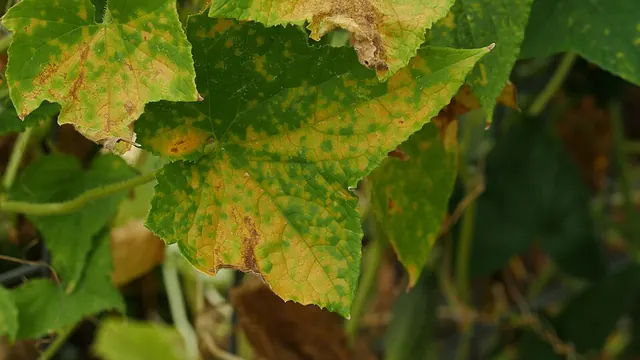
Signs
- Yellow or pale patches on the upper surface, squared off by the veins.
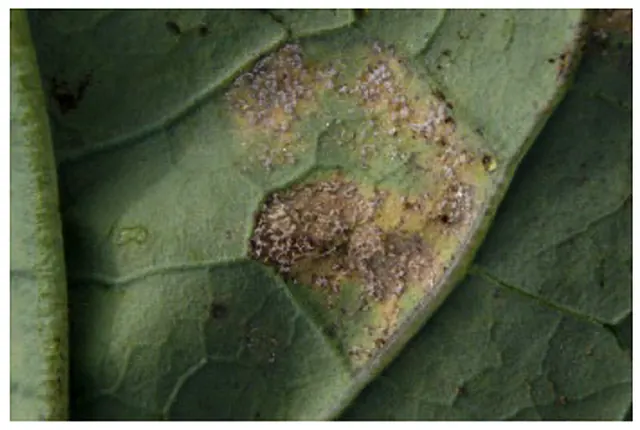
- Gray or purplish-gray fuzz on the underside below those patches, in humid weather.
- Patches turn brown and dry; basil leaves develop black spots.
Risk Factors
Cool, humid nights with dew or leaf wetness for several hours, and spores carried long distances on air currents.
Prevention
- Grow resistant varieties.
- Water in the morning at the base; reduce leaf wetness and night humidity.
- Space plants; ventilate greenhouses to lower humidity.
Host Crops
Cucumber, squash & melon; Lettuce, spinach & herbs; Cabbage family (broccoli, kale, cabbage); Roses & ornamentals; Hemp & cannabis; Beans & peas.
Look-Alikes
Sources
- Downy mildew of cucumber, melon and squashUniversity of Minnesota Extension
- Basil downy mildewUniversity of Minnesota Extension
- Downy Mildew on FlowersUniversity of Maryland Extension
Treatment by crop
Cultural, biological and chemical options in the order to use them, and notes written for each crop.
Identification is free. Treatment is on the Pro plan.
Diagnosis Path
- Look the plant over, leaf undersides included. Are insects, mites, slugs, eggs, webbing or droppings on it?
No, only damage or discoloration - Where is the problem?
Leaves - What does the leaf damage look like?
A coating or growth on the surface - What is the coating like?
Gray or purplish fuzz on the underside
Not a match? Start the key or describe what you see.
More photos
Leaves that stay wet in still air let downy mildew get started. The Airflow Planner shows where a greenhouse fan layout leaves still air.
More from university Extension: search Extension pages on downy mildew, or find your state's plant diagnostic lab.
Other diseases
- Anthracnose
- Apple scab
- Bacterial leaf scorch
- Bacterial leaf spot
- Bacterial wetwood (slime flux)
- Bacterial wilt of cucurbits
- Black knot
- Black rot of the cabbage family
- Black spot of rose
- Bleeding canker
- Boxwood blight
- Brown rot of stone fruit
- Canker diseases
- Cedar-apple and related rusts
- Clubroot
- Common scab of potato
- Crown gall
- Damping-off
- Dutch elm disease
- Early blight and Alternaria leaf spot
- Elm yellows (phloem necrosis)
- Fire blight
- Fusarium wilt
- Gray mold (Botrytis)
- Hop latent viroid
- Late blight
- Mosaic viruses
- Needle cast and tip blight
- Oak wilt
- Peach leaf curl
- Powdery mildew
- Root and butt rot
- Root rot (Pythium and Phytophthora)
- Rust
- Septoria leaf spot
- Shade tree anthracnose
- Sooty mold
- Tar spot of maple
- Tomato spotted wilt and impatiens necrotic spot viruses
- Verticillium wilt
- White mold (Sclerotinia)
- White pine blister rust