Plant Problem Diagnosis Key / Growing conditions
Herbicide injury
Growth-regulator herbicides (2,4-D, dicamba, clopyralid, aminopyralid) twist and cup new growth at tiny doses. They arrive as spray drift, or in compost, manure, hay or straw from treated fields, where they last for years.
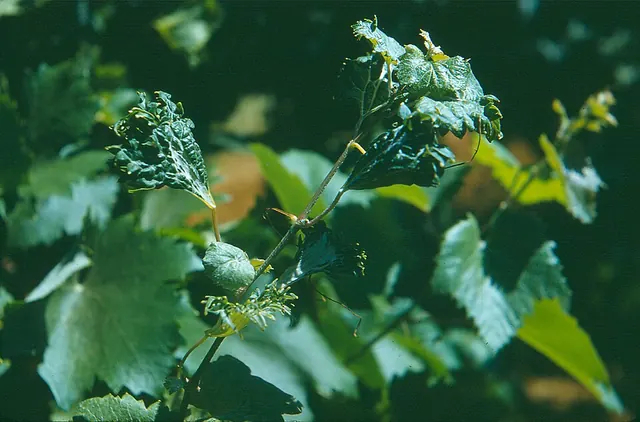
Signs
- New leaves cupped, strap-like or fan-shaped; stems twisted and bent.
- Several kinds of plants affected at once, in a pattern that follows the wind or the new mulch or compost.
- Tomatoes, peppers, beans and grapes are most sensitive.
What favors it
Spray drift on warm, windy days; vapor from dicamba and some 2,4-D forms; compost, manure, hay or straw from fields treated with clopyralid, aminopyralid or picloram.
Prevention
- Ask suppliers whether manure, compost, hay or straw came from treated fields.
- Run a bioassay before using a new amendment: grow peas or beans in it for 2-3 weeks beside a plain-mix control and watch for cupping.
- Spray lawn weeds on calm, cool days, away from gardens.
Often confused with
Sources
- Herbicide injury on garden plantsUniversity of Minnesota Extension
- Herbicide Injury - Synthetic AuxinsMontana State University Extension
- Herbicide Damage on VegetablesUniversity of Maryland Extension
- Herbicide Carryover in Hay, Manure, Compost, and Grass ClippingsOregon State University Extension
Treatment by crop
Cultural, biological and chemical options in the order to use them, and notes written for each crop.
Identification is free. Treatment is on the Home and Pro plans.
Questions in the key that lead here
- Look the plant over, leaf undersides included. Are insects, mites, slugs, eggs, webbing or droppings on it?
No, only damage or discoloration - Where is the problem?
Leaves - What does the leaf damage look like?
Shape change - What has the leaf done?
New growth curled, puckered or twisted - Look under the curled leaves.
Strap-like leaves and bent stems, on several plants
Not a match? Start the key or describe what you see.
More from university Extension: search Extension pages on herbicide injury, or find a plant diagnostic lab through your state's Extension.
Other growing conditions
- Blossom drop
- Blossom-end rot
- Cold and frost injury
- Construction and root damage
- Drought stress (underwatering)
- Edema (oedema)
- Fruit cracking
- Girdling roots and a buried root flare
- Heat and light stress
- Leaf scorch and drought stress
- Light bleaching
- Mower, trimmer and animal injury
- Normal fall needle drop
- Not enough light (stretching)
- Overwatering (low root oxygen)
- Road salt injury
- Southwest injury (winter sunscald and frost cracks)
- Sunscald
- Transplant shock
- Winter burn of evergreens